
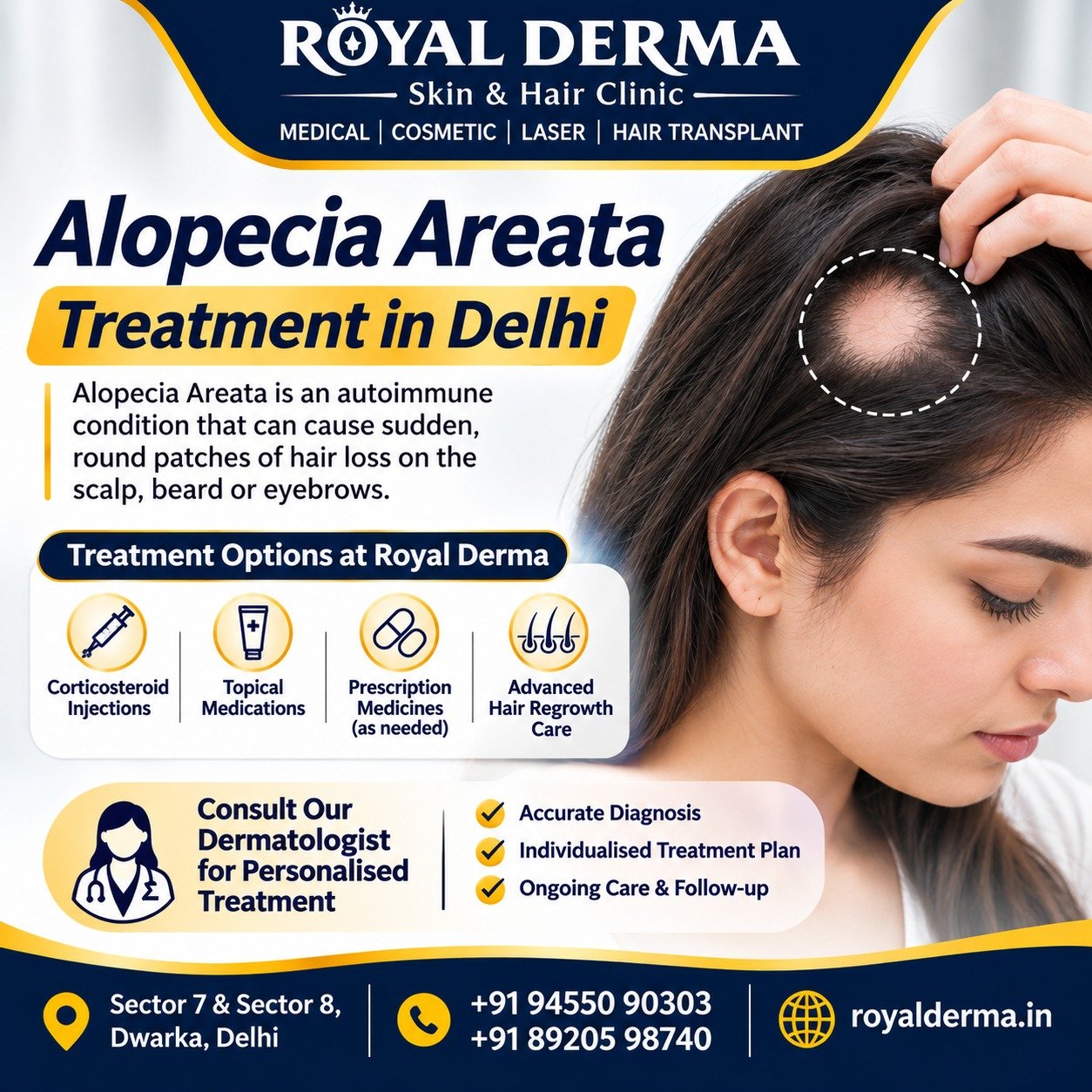
Alopecia Areata Treatment in Delhi – Causes, Symptoms & Treatment Options
Have you noticed sudden, round or oval patches of hair loss on your scalp, beard or eyebrows? This could be a sign of Alopecia Areata, an autoimmune condition that affects hair follicles.
If you are looking for Alopecia Areata Treatment in Delhi, understanding the condition, its symptoms and available treatment options is an important first step. A dermatologist can evaluate your condition and recommend a personalised treatment plan.
What Is Alopecia Areata?
Alopecia Areata is an autoimmune condition in which the immune system mistakenly targets hair follicles. It commonly causes sudden, patchy hair loss without usually damaging the hair follicles permanently.
The condition can affect different areas of the body, including:
- Scalp
- Beard and moustache
- Eyebrows
- Eyelashes
- Other areas of body hair
Alopecia Areata can affect people of different ages. Its course varies from person to person, and hair regrowth may occur in some cases.
Common Signs and Symptoms of Alopecia Areata
Recognising the early signs of Alopecia Areata can help you seek timely dermatological evaluation.
1. Round or Oval Patches of Hair Loss
One of the most common signs is the sudden appearance of smooth, round or oval patches where hair has fallen out.
2. Hair Loss on the Scalp
Hair loss may begin with one or more patches on the scalp. In some individuals, it may affect larger areas.
3. Beard Hair Loss
Alopecia Areata can also affect facial hair, resulting in patchy areas in the beard or moustache.
4. Eyebrow or Eyelash Hair Loss
In some cases, the condition may affect eyebrows and eyelashes. These changes should be evaluated by a dermatologist.
5. Changes in Nails
Some people with Alopecia Areata may also notice small dents, ridges or other changes in their fingernails.
What Causes Alopecia Areata?
Alopecia Areata is an autoimmune condition. It develops when the immune system mistakenly attacks hair follicles and interrupts normal hair growth.
Some factors associated with the condition include:
- Immune system activity affecting hair follicles.
- Genetic susceptibility or family history.
- Association with certain other autoimmune conditions.
- Individual biological and environmental factors.
Stress may be associated with the onset or worsening of symptoms in some individuals, but it is not considered the sole cause of Alopecia Areata.
Important to Know:
Alopecia Areata is not contagious. It cannot spread from one person to another through physical contact.
Alopecia Areata Treatment Options
There is no single treatment suitable for everyone with Alopecia Areata. Treatment depends on factors such as the person’s age, extent of hair loss, affected areas, duration of the condition and medical history.
1. Corticosteroid Injections
Intralesional corticosteroid injections may be considered by a dermatologist for selected patients with limited patchy hair loss. They help reduce inflammation around affected hair follicles.
2. Topical Medications
Prescription topical treatments, including corticosteroid preparations, may be recommended for certain patients. The choice depends on the affected area and clinical assessment.
3. Prescription Medicines
For more extensive or persistent Alopecia Areata, a dermatologist may consider other prescription treatment options. Certain advanced medicines, including JAK inhibitors, may be suitable for selected patients after careful evaluation.
4. Individualised Hair Regrowth Care
Regular follow-up and monitoring help assess the condition and response to treatment. Additional hair and scalp care may be discussed according to individual needs.
Why Is Personalised Treatment Important?
Alopecia Areata can behave differently in different individuals. Treatment selection should be based on proper diagnosis and the extent of hair loss rather than using the same approach for everyone.
How Is Alopecia Areata Diagnosed?
A dermatologist usually evaluates the affected areas and reviews the patient’s medical history. Diagnosis may involve:
- Examination of the scalp, beard or other affected areas.
- Assessment of the pattern of hair loss.
- Dermoscopy or trichoscopy when required.
- Additional tests or investigations if another condition is suspected.
Early professional assessment can help distinguish Alopecia Areata from other causes of patchy hair loss.
When Should You Consult a Dermatologist?
Consider consulting a dermatologist if you notice:
- Sudden round or oval patches of hair loss.
- Increasing areas of patchy hair loss.
- Hair loss affecting your beard or eyebrows.
- Changes in nails along with hair loss.
- Repeated episodes of unexplained patchy hair loss.
A qualified dermatologist can assess your symptoms and discuss suitable treatment options.
Alopecia Areata Treatment at Royal Derma Skin & Hair Clinic, Dwarka
Royal Derma Skin & Hair Clinic provides dermatology consultation for skin and hair-related concerns in Dwarka, Delhi.
If you are experiencing patchy hair loss or suspect Alopecia Areata, a dermatologist consultation can help evaluate the condition and discuss appropriate treatment options.
Depending on clinical assessment, treatment discussions may include:
- Corticosteroid injections for suitable cases.
- Topical medications.
- Prescription medicines when appropriate.
- Individualised hair and scalp care with follow-up.
The treatment plan is based on the individual’s condition, and results may vary from person to person.
Frequently Asked Questions About Alopecia Areata
1. Is Alopecia Areata an autoimmune condition?
Yes. Alopecia Areata is an autoimmune condition in which the immune system mistakenly targets hair follicles, leading to patchy hair loss.
2. Can hair grow back after Alopecia Areata?
Hair regrowth is possible in many cases, but the course of the condition varies. Some people may experience recurrence or more extensive hair loss.
3. Is Alopecia Areata contagious?
No. Alopecia Areata is not contagious and does not spread through physical contact.
4. Which doctor treats Alopecia Areata?
A qualified dermatologist is the appropriate specialist to diagnose Alopecia Areata and discuss treatment options.
5. Is there a permanent cure for Alopecia Areata?
There is currently no guaranteed permanent cure. Treatment can help manage the condition in suitable patients, but recurrence is possible.
6. Where can I consult a dermatologist for Alopecia Areata in Dwarka?
You can contact Royal Derma Skin & Hair Clinic at its Sector 7 and Sector 8 locations in Dwarka, Delhi, for appointment information.
Consult a Dermatologist for Alopecia Areata in Delhi
Royal Derma Skin & Hair Clinic
MEDICAL | COSMETIC | LASER | HAIR TRANSPLANT
Sector 7 Clinic:
Ground Floor, Rohit Plaza, E-517, Ramphal Chowk Road, Block E, Sector 7, Dwarka, Delhi – 110075.
Sector 8 Clinic:
1st Floor, Plot No. 1, Near Yadav Bhawan, Bagdola, Sector 8, Dwarka, New Delhi – 110077.
Call for Appointment:
+91 94550 90303
+91 89205 98740
Website:
www.royalderma.in
Disclaimer: This article is for general educational purposes only and does not replace professional medical diagnosis or treatment. Treatment suitability and results vary between individuals.