
ROYAL DERMA SKIN & HAIR CLINIC
Hair Transplant vs PRP Therapy: Which Hair Restoration Treatment Is Right for You?
Experiencing hair fall, thinning hair or a receding hairline? Understanding the difference between hair transplant vs PRP therapy can help you discuss suitable treatment options with a qualified medical professional.
Hair loss can have several causes, including hereditary factors, hormonal changes, medical conditions and scalp-related concerns. The appropriate approach depends on the underlying cause, the pattern of hair loss and your individual health needs.
Two options people commonly explore are hair transplantation and Platelet-Rich Plasma (PRP) therapy. Although both are associated with hair restoration, they work differently and are used for different purposes.
At Royal Derma Skin & Hair Clinic, individuals in Dwarka, Delhi, can enquire about hair and scalp assessment to understand their concerns and discuss appropriate treatment options.
Hair Transplant vs PRP Therapy: Key Differences
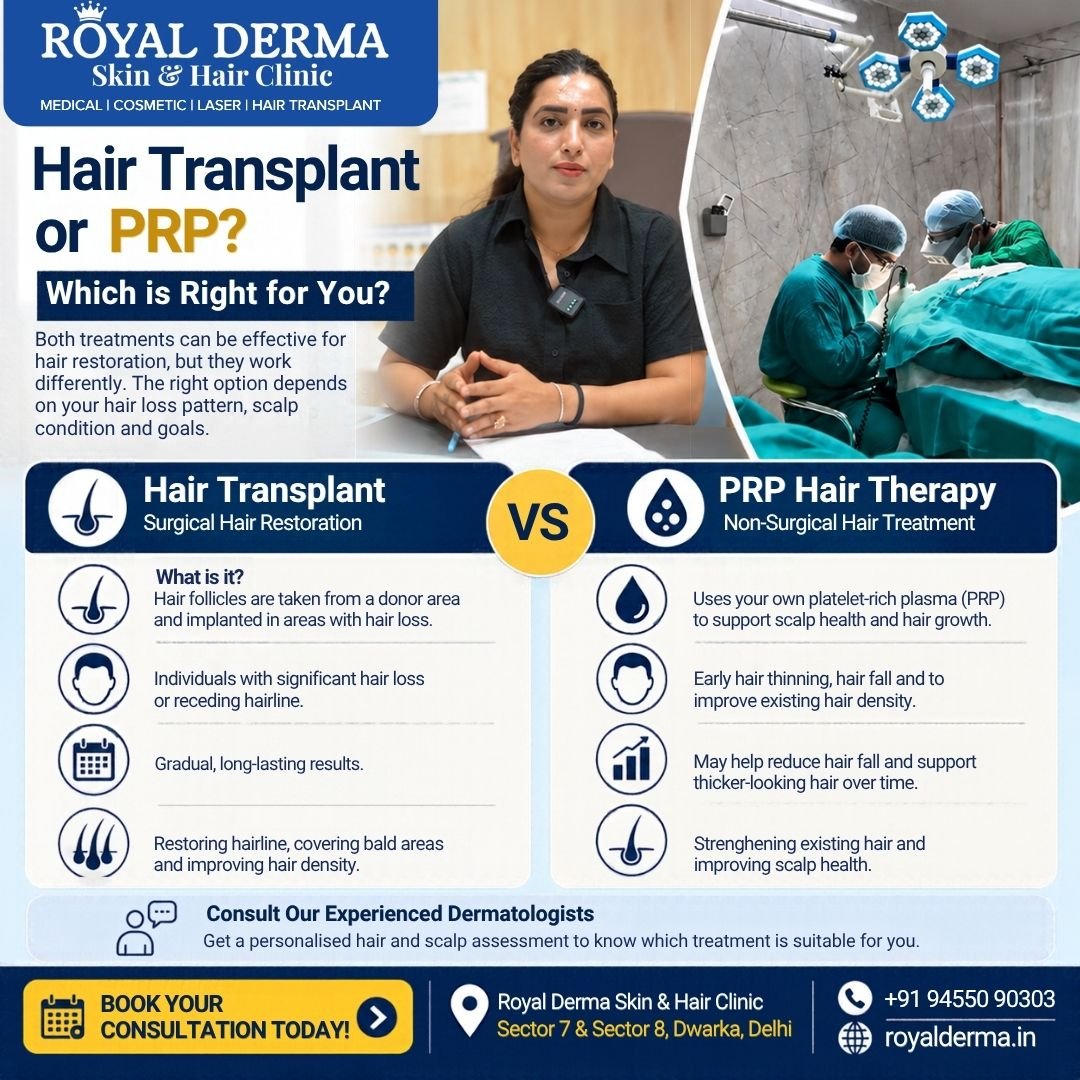
The main difference is that a hair transplant is a surgical procedure that moves hair follicles to areas affected by hair loss, whereas PRP therapy uses platelet-rich plasma prepared from your own blood and injected into selected areas of the scalp.
| Feature | Hair Transplant | PRP Therapy |
|---|---|---|
| Treatment type | Surgical hair restoration | Non-surgical treatment involving scalp injections |
| How it works | Moves follicles from a donor area to selected areas | Uses platelet-rich plasma prepared from your blood |
| Potential use | Selected cases of patterned hair loss | Selected cases of hair thinning or hair loss |
| Treatment plan | Usually a planned surgical procedure with aftercare | May involve a series of sessions and follow-up |
| Results | Develop gradually over several months | Response varies; improvement is not guaranteed |
What Is a Hair Transplant?
A hair transplant is a surgical procedure in which hair follicles are taken from a donor area, commonly the back or sides of the scalp, and placed in areas where hair coverage has reduced.
Common techniques include Follicular Unit Extraction (FUE) and Follicular Unit Transplantation (FUT). The technique selected depends on factors such as donor hair availability, scalp characteristics, treatment goals and the surgeon’s assessment.
Potential Benefits of Hair Transplantation
✔ May restore hair coverage in selected areas.
✔ Can help create a planned hairline based on individual features.
✔ May provide long-lasting growth from successfully transplanted follicles.
✔ Can be considered when sufficient suitable donor hair is available.
Hair transplantation is not suitable for everyone. A medical assessment is necessary to determine the cause of hair loss, evaluate donor hair and discuss potential risks, scarring, recovery and realistic expectations.
What Is PRP Hair Therapy?
Platelet-Rich Plasma (PRP) therapy uses a portion of a patient’s own blood that is processed to concentrate platelets. The prepared plasma is then injected into selected areas of the scalp according to the treatment plan.
PRP may be considered for certain types of hair thinning. However, its effectiveness varies, and it does not reliably restore hair in every case or replace the need to identify and manage the cause of hair loss.
What to Know About PRP Therapy
✔ Uses blood collected from the individual receiving treatment.
✔ Does not involve surgically moving hair follicles.
✔ May require multiple sessions, depending on the treatment plan.
✔ Results and suitability differ between individuals.
Hair Transplant or PRP: Which Is Better?
Neither treatment is universally better. The appropriate choice depends on the type of hair loss, its severity, donor hair availability, scalp health, medical history and treatment goals.
When a Transplant May Be Considered
A transplant may be discussed for suitable individuals with established hair loss, a suitable donor area and realistic expectations about coverage and future hair loss.
When PRP May Be Considered
PRP may be discussed for selected individuals experiencing hair thinning when a clinician considers it appropriate after assessing the scalp and possible causes.
In some cases, a clinician may discuss combining different hair-loss management approaches. Any combination should be based on an individual assessment rather than a standard package offered to everyone.
How Long Does It Take to See Results?
Hair restoration is a gradual process. After a hair transplant, the transplanted hairs may shed before new growth becomes visible over the following months. Further maturation can take longer, and final outcomes vary.
PRP response also varies. Some people may experience improvement in selected hair-loss measures, while others may see limited benefit. A clinician can explain the expected timeline, possible number of sessions and how progress will be reviewed.
Neither procedure guarantees a particular hair density or outcome. Existing hair may continue to thin, so ongoing management may be recommended when appropriate.
Why Is a Hair and Scalp Consultation Important?
Before choosing hair transplant or PRP therapy, a qualified medical professional can assess your scalp, hair-loss pattern, medical history and donor hair where relevant. This assessment helps establish whether treatment is appropriate and whether other causes need to be investigated.
If you are searching for hair restoration treatment in Dwarka, Delhi, ask about the clinician’s qualifications, treatment risks, expected outcomes, aftercare and follow-up arrangements before making a decision.
ROYAL DERMA SKIN & HAIR CLINIC
Explore Your Hair Restoration Options
Discuss your hair-loss concerns and learn which treatment options may be appropriate for your individual needs.
📍 Sector 7 & Sector 8, Dwarka, Delhi
📞 +91 94550 90303 | +91 89205 98740
🌐 www.royalderma.in
Frequently Asked Questions
1. Is PRP better than a hair transplant?
Neither is always better. A transplant moves hair follicles, while PRP uses prepared plasma injected into the scalp. The appropriate option depends on the cause and pattern of hair loss and individual suitability.
2. Can PRP replace a hair transplant?
PRP does not move follicles into bald areas and cannot be assumed to replace transplantation. It may be considered for selected types of hair thinning after a medical assessment.
3. Is PRP hair therapy a surgical procedure?
No. PRP is a non-surgical treatment involving blood collection, processing and injections into selected scalp areas. It can still cause temporary discomfort or other side effects.
4. Are hair transplant results permanent?
Transplanted follicles may provide long-lasting growth, but results vary. Hair in untreated areas may continue to thin, and ongoing management may be needed.
5. How many PRP sessions are needed?
The number and frequency of sessions depend on the individual’s condition and the clinician’s treatment plan. There is no single schedule suitable for everyone.
6. Where can I enquire about hair restoration in Dwarka, Delhi?
You can contact Royal Derma Skin & Hair Clinic at Sector 7 or Sector 8, Dwarka, Delhi, to enquire about consultation availability and hair restoration services.
Make an Informed Decision About Hair Treatment
A professional assessment can help you understand your options, treatment suitability and realistic expectations.